
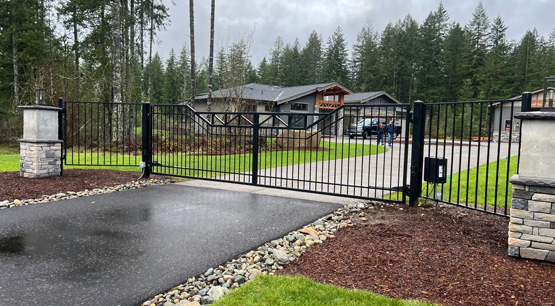
Automated gates used to feel fancy, but for many homes, they’re now a practical way to control who comes and goes. A powered gate turns your driveway into a managed entry, which makes quick, uninvited stops far less likely. Just as important, it makes daily routines easier. No stepping out in the rain to push a heavy panel. No wondering if you left the gate open. With the right setup, you tap a remote, enter a code, or use an app, and the gate does the rest. In this guide, we’ll cover how these systems improve security, the parts that matter, simple access options, key safety gear, design choices, power setup, and where a trusted local team can help you plan and install.
A Strong First Barrier That Discourages Trespassing
A closed, motorized gate sends a clear message: this entry is controlled. That alone stops a lot of casual trespassing. The delay it creates is significant. Someone can’t just turn into your drive and be at the front door in seconds. They meet a gate that opens only when you allow it. Most residential openers include features that support this goal, such as an auto-close timer.
If you set the timer to thirty or sixty seconds, the gate closes after your vehicle passes, so it never stays open by accident. Some controllers keep a time-stamped log of opens and closes, and app-ready models let you check status while you’re away. Pair the gate with motion lighting and a driveway camera pointed toward the street. This gives you visibility of plates and faces without being intrusive. Put it together, and you get a simple but effective pattern: delay, verify, and decide who gets in.
Core Parts That Keep An Opener Reliable
A dependable system is more than a motor. It’s a set of parts that work together without strain. Key items include:
- Operator (motor unit): Look for soft-start and soft-stop. These features ramp movement to reduce stress on hinges, rollers, and posts.
- Control board: The small circuit panel that connects remotes, keypads, sensors, and app modules.
- Drive method: Chain or rack for sliding gates; linear arm for swing gates. Pick the style that matches your gate design and weight.
- Limit switches: Tell the opener when the gate is fully open or closed, so it never keeps pushing.
- Weather-rated housing: Protects electronics from dust and rain.
- Manual release: A keyed lever that lets you move the gate by hand during a power issue.
Match every part to gate size, panel material, and expected daily use. An opener rated for 300–500 cycles per day is overkill for a quiet street; a light-duty unit will serve most homes well when the gate is hung square, and hardware is aligned.
Simple Ways To Let Family And Guests In
You don’t need to hand out more metal keys. Modern openers support several easy, secure methods:
- Remote fobs: Keep one in each car for one-touch entry.
- Keypads with PINs: Set a main code for the family and short-term codes for guests or deliveries.
- App control: Open, close, and check status from your phone. Get alerts if the gate is left open.
- Intercom or call-to-open: Visitors press a button; you answer and allow entry.
- Vehicle tags or plate readers: Helpful where frequent users need hands-free entry.
For radio security, choose rolling-code remotes so the signal changes every time you press the button. On the keypad, enable lockout after several wrong tries. If you use an app, set a strong password and turn on two-factor sign-in. A simple policy helps too: review who has codes twice a year and remove anything you no longer need. These small habits keep entry simple for you and harder for everyone else.
Safety Devices That Protect Cars And People
Good security should always work hand-in-hand with safety. Two standards guide the industry: UL 325 (for gate operators) and ASTM F2200 (for gate design). Ask for systems that follow both. The most common safety devices you’ll see are:
- Photo-eye sensors: An invisible beam across the driveway; if the beam breaks, the gate stops and reverses.
- Contact edges: Soft edges on the leading side that detect light pressure and stop movement.
- Current sensing: The opener monitors force and reverses if it meets unusual resistance.
- Warning light and beeper: Flashing light and short beeps signal that the gate is moving.
Place photo eyes at bumper height, and consider a second set lower if pets roam near the driveway. Keep shrubs away from the travel path, and test monthly with a light object like a pool noodle. If anything fails a test, call a pro before using the gate again. Clear paths, working sensors, and a quick monthly check keep people, pets, and cars out of harm’s way.
Choosing Sliding, Swing, Or Vertical Gate Styles
Your driveway and yard shape usually decide the best style. Sliding gates roll sideways on a track or glide on cantilever hardware. They shine where a slope would cause a swing gate to scrape, or where space behind the gate is tight. Swing gates open like a door and suit many homes, single leaf for narrow drives, dual leaf for wider openings. They look classic and are straightforward to service when posts are set deep, and hinges are aligned.
A vertical lift gate rises straight up and fits very tight lots, though it’s less common for homes. Think about the small details: where a car waits while the gate moves, how wind hits a solid panel, how leaves and snow collect on a track, and whether a swing arc might hit a parked bumper. A short site check often saves time and avoids rework later.
Power Options, Batteries, And Smooth Daily Operation
Most openers plug into normal household power, with a small transformer feeding low-voltage control circuits. Ask for a dedicated circuit and a weather-rated shutoff so service is safe and quick. For outages, many units include or support a battery backup. Expect a handful of open/close cycles from the battery; it’s there to get you through a short loss, not to run the gate all week. On long driveways where power is far, a solar kit can charge the battery.
These work best with efficient DC motors and moderate daily use. To protect electronics, include a surge protector, seal every conduit entry, and mount control boxes above any standing water line. Twice a year, check battery terminals, wipe dust from boards, and confirm the charger shows normal status. Small steps keep the opener quiet, smooth, and ready when you press the button.
Conclusion
Automated gates make it harder for strangers to roll in and make daily exits and returns easier for you. Choose a design that fits your driveway, add the safety gear that keeps people and cars protected, and power it with a setup that handles your location. Keep the maintenance list short and regular. When you want help, reach out to the team that does this every day. Call or message LeGrand Fence Contractors LLC now to schedule your visit and get your gate project moving. A quick site check and a simple plan are often all it takes to add real control at your driveway, with a setup that works smoothly from the first week onward.